I once told Jeffrey Bragg about a training run I had with 16 dogs attached to my four-wheeler. He responded by telling me I should never have that many dogs on a dry training run because no one could safely handle that many. I responded by reminding him that Leonhard Seppala often ran as many as 24 dogs on snow and ice. Bragg’s rebuttal was brief and to the point.
“You,” he said, “are no Leonhard Seppala.”
I wanted to argue my prowess as a dog trainer, but one thing I could not argue: I am not Leonhard Seppala. No one is. By many reasonable accounts, he was the greatest musher of all time.

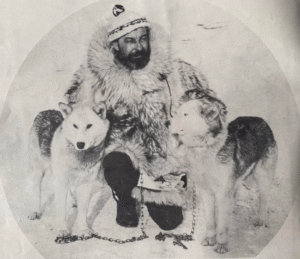
*Leonhard Seppala — photograph property of Jonathan Hayes*
—
**The Early Years**
At the end of his career, Leonhard Seppala was known as “the Big Norwegian,” although he stood only five feet four inches tall and weighed 145 pounds. He was born in Skibotn, Norway, north of the Arctic Circle, in the summer of 1877 — the son of a blacksmith and arctic fisherman.
Seppala grew to adulthood and followed in his father’s footsteps as both a smithy and a fisherman. But in 1899, when a friend returned to Norway rich from the goldfields of Alaska, the lure of wealth and adventure proved too much for the twenty-two-year-old to resist, and before long he was on his way to the new world.
Shortly after arriving in Alaska, Seppala’s employer gave him the opportunity to take a dog team out prospecting. The two 100-pound mongrels were the best way to travel in the frozen tundra. Seppala’s life would never be the same again. He was a musher.
Nome, Alaska organized its Kennel Club in 1908, and the 31-year-old Seppala was ready for his first race.
Seppala tells the story that he won that first race due to the intervention of a raven. The bird kept landing in the trail just ahead of the team, and the dogs would pour on the steam to catch it, only to be teased as it flew away at the last moment and landed again just ahead. Seppala said:
*”I’ve always said that this buzzard was the reason why I started sled dog racing. The fact that I won that race started my career as a sled dog racer.”*
The very next year, Nome held its second annual 500-mile All Alaska Sweepstakes Race. Seppala was not yet ready to enter the longest of races. Everyone looking on was quite amused when a Russian fur trader named William Goosak pulled into the starting chute with some half-sized “bushy-tailed rat dogs” he had imported from Siberia. The odds were set at 100 to 1 against these Siberian runts. However, everyone in the Nome Kennel Club was shocked — and the Nome Bank nearly bankrupted — when the Siberian dogs came in third place. Onlookers noted that the little dogs seemed as energetic at the finish as when they had left the starting chute. Some later claimed the Nome Bank had bribed Goosak to throw the race to avoid going under.

*Seppala and his Alaska Sweepstakes team — photograph property of Jonathan Hayes*
Leonhard Seppala — “Sepp,” as he was called by his friends — received his first team of Siberian Husky imports from his employer to train in 1913, a few years after Goosak’s original import and the subsequent import of Siberians by Charles “Fox” Maule Ramsey. Sepp raced these young Siberian dogs the very next year in the All Alaska Sweepstakes Race but had to scratch due to a blinding blizzard. This did not deter him, however — he won the Sweepstakes the following three consecutive years. Those three wins made him and his Siberian Huskies famous. But Seppala was not through yet.
He probably would have continued to dominate the Sweepstakes had the race not been brought to an abrupt end, with many sled dogs being deported to Europe as the world was drawn into its first World War. By the time the war ended, air transportation was becoming a reality even in these northern regions, and the age of the sled dog appeared to be quickly drawing to a close.
—
**Seppala Shines**
I have always felt that great men need great challenges in order to shine. If the story of Seppala ended here, we would probably not be thinking of him now, nor working to preserve the breed he labored so hard to establish. His greatest test came in the winter of 1925, when the advent of the airplane was already driving the final nails into the coffin of dog sled transportation in the north.
A diphtheria epidemic had broken out in Nome, Alaska. “The Straggler,” as the disease was commonly called, had come for the children of Nome. The antitoxins that Doctor Welch had ordered had not arrived in the last shipment.
Nome was, as it is today, completely cut off from the outside world in winter. No passable roads. The port iced in for miles. The only way in after the snow flies is by plane — and when temperatures dropped far below zero, the aircraft of the 1920s were unreliable and dangerous at best.
There were brave pilots in Anchorage who wanted to fly the serum to Nome, but no one had ever successfully made such a journey under such conditions. The debate was taken to the floor of the United States Senate in Washington, D.C.: should they give the modern age a chance and risk losing the only serum in the area, or send it the slower but most reliable way — with the dog mushers?
The people of Nome had another idea. Leonhard Seppala lived there and ran his dogs year-round for the Pioneer Mining Company out of that coastal town. Everyone knew Sepp’s abilities. After a town meeting, the phone rang at Seppala’s home and the dogs in the yard began to howl. They asked him to begin traveling toward Nenana. The serum would be transported to Nenana by train, and they wanted the 640 miles between the two towns traversed by dog team. A musher would head out from Nenana to meet Seppala somewhere in the middle. Nome was willing to put all its hope into one basket — Seppala’s sled basket.
While Sepp was on the trail, the Governor of Alaska picked up on the plan but could not entrust the fate of Nome to a single musher. So, as politicians are apt to do, the Governor complicated the plan by expanding it to include some 20 teams and mushers in a relay. The problem was — how would the already-traveling Seppala be told he was not to transport the serum alone?
Seppala ultimately traveled a total of 261 miles to save the children of Nome. Few mushers would dare cross Norton Sound even once, and most would have wasted valuable time going around it. Seppala crossed the treacherous sea ice of Norton Sound twice to save time — once going out to receive the serum, and again on the way back.
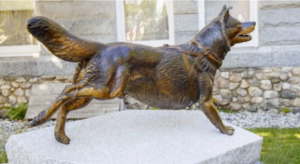
He then transferred the serum to the next musher as instructed. Gunnar Kaasen, however, did not hand the serum to the next waiting musher but carried it the rest of the way into Nome himself. Kaasen received most of the early press despite having traveled only 53 miles. His freight leader Balto — actually a dog culled from Seppala’s own team — became the celebrated hero of the “Race for Life.” New York invited Kaasen and Balto for the dedication of a statue erected in Balto’s honor. Seppala was hurt that his dog Togo, the true hero of the run, was not receiving his just recognition.

*Seppala and Togo*
Within the year, after the dust had settled, Seppala and Togo began to be recognized for their accomplishments. In October of 1926, Seppala and his team were brought to the lower 48 states for a tour and honored at Madison Square Garden with a medal presented by the famed explorer Roald Amundsen.

*Seppala and his Siberians en route from Alaska to Washington — photograph property of Jonathan Hayes*
For an overview of the history of Seppala in Maine and the establishing of Poland Spring Kennel, click the link above entitled “Poland Spring Derby.”
— Jonathan Nathaniel Hayes