“You just have to be as smart as the dogs. Most people aren’t.” Moore replied.

All photos in this article are from the author’s personal collection.
INTRODUCTION
I have often said Maine has a mushing history second only to Alaska, and I have written much to substantiate this claim. Leonhard Seppala and Elizabeth Riccar established the very first Seppala Siberian Kennel at Poland Spring, Maine. The first explorer to attain the North Pole, Robert Peary, and polar explorer Donald MacMillan—both Mainers—planned and launched their arctic expeditions from Maine. Perry Greene attempted a sanctioned summit of Maine’s Mt. Katahdin by dogteam. Antarctic explorer Arthur Walden brought his team of original Chinooks to the Annual Maine Sled Dog Derby.
We quickly forget our history if the stories aren’t retold. For example, the Baxter Park trail-masters told me that no dogsled attempt on the summit had ever been made, until I produced the newspaper articles to prove it.
The story of Cecil “Mush” Moore and his trans-continental dogsled expedition from Fairbanks, Alaska to Lewiston, Maine is another such story. I first heard of Moore 25 years ago when I was just a year or two into my journey to becoming a musher. I met his great niece at the Lewiston/Auburn Walmart where I was working night shifts after my time in the Marine Corps. She overheard that I was an aspiring musher and that my hopes were to someday mush across the continent. She chimed in:
“My great uncle is a famous musher. He once mushed from Fairbanks Alaska to his home here in Lewiston, Maine.”
The next night she brought in a three-ringed binder with all kinds of newspaper clippings and other memorabilia. I skipped my lunch break the next two nights, choosing rather to devour every word of those remembrances. Since then I have collected what articles and personal letters I could find of his adventure. I want to especially thank Cathy Hoy who donated her family collection to me.
Recently a photo of Mush Moore has been circulating on social media. I cannot tell you how many folks sent the post to me in messenger, asking me what I know of the expedition or the man. So I have decided to write this article. What follows is a synthesis of information I have compiled from articles, booklets, hand-written notes and first-hand accounts of relatives. But I consider this a “work in progress” and will add to, and amend, this telling as I receive further knowledge from his descendants or those who knew him.

The Musher: CECIL A. “MUSH” MOORE
Maine native Cecil Moore was an adventurer long before he fell in love with sled dogs. As a structural iron worker he had traveled all over the United States—and the world—on construction contracts as foreman. He worked in places as far flung as Morocco, Iceland, and Africa. He was foreman on the construction of the Augusta Bridge which, at time of construction, was the largest spanned bridge in the world (completed in 1949). But it was on a contract to Alaska that he fell in love with working dogs and the frozen wilderness.
When his contract ended in Alaska, Cecil Moore was nearly 41 years old. Rather than leave his new passion for sled dogs behind, Moore decided he would mush his eleven-dog team back to his family home in Lewiston, Maine. There, he would share his newfound passion with his wife Jane and his teen son, Bronson.
As an interesting aside, Cecil’s son inherited his father’s sense of adventure. Excited by the war effort, Bronson lied about his age to enlist in the National Guard at the age of fifteen!
Moore also hoped to use his expedition as a fundraiser for the boys’ orphanage (Healy Asylum) in Lewiston, Maine.
“I was a poor boy too. And now I’d like to help other boys who need guidance, comfort and encouragement,” Mush said. “I want to prove that modern man can cope with wilderness, alone and depending only on his dogs. At the same time I wish to raise funds for the orphanage.”
Cecil intended to found the “Cecil A. Moore Fund” from subsequent lectures, presentations, and endorsements.
THE EXPEDITION
Mush Moore departed Fairbanks, Alaska on November 14, 1949, with his 11 huskies on a bone-chilling -30 degree Fahrenheit day. He was using a custom-built sled/wheeled cart designed and constructed by the Philadelphia-based “Flexible Flyer” wagon company.

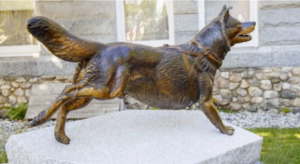
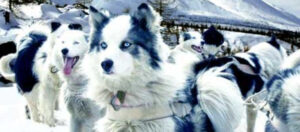
His dogs were a mix of Alaskan village dogs. His leader was a bitch named Minga. “My beautiful Point Barrow Eskimo Dog,” as he lovingly referred to her. She was reported to be ¾ wolf and 8 years old by the completion of the trek. Minga gave birth to 6 pups on the trail, contributing to the overall total of a whopping 55 puppies born during the 17-month trek, as Moore later reported in a radio interview.
“Part wolf” was a common misconception of arctic sled dogs during Moore’s day. And I am certain he fully believed it was true of the dogs he mushed back to Maine with him. This “Jack London, Call of the Wild” trope was almost never actually true, however. Despite their great endurance and strength, wolves and wolf-hybrids generally make for terrible sleddogs. Modern genetics show that arctic spitz dogs had diverged from their wild cousins hundreds of years earlier.
For the first eight weeks of Moore’s trip, it never rose above -30°F. When temperatures dipped to colder than -45°F, Moore would hold up until the weather improved for his dogs’ sake. At the end of his first week he wrote home the following:
“It has been a week since I left civilization behind me. In this week I have lived every moment … a day, a week or forever. I have seen Nature and have lived in my mind all these moments, doing this or that at some place in the trail, maybe just to climb up to one of the peaks that surround me, to know that I have conquered one of Nature’s mightiest and most majestic sentinels of this most silent solitude … or maybe my thoughts were on a rabbit that was being chased by a fox.”
By February 23, 1950, Moore had reached Highland Ridge in Canada’s Yukon. The temperatures plummeted to a life-threatening -75°F.
“I didn’t dare sleep that night. When it gets that cold you don’t know if you are freezing to death. I kept moving. All night. Chopping firewood, feeding the fires and drinking piping hot tea. The dogs burrowed in the snow and covered their noses with their bushy tails. I tossed them fish, but they ignored it, knowing their noses would freeze if they opened to the cold.”
The first 2,200 miles across Yukon and British Columbia were the toughest. Cecil Moore navigated five mountain ranges, 129 rivers, and 21 lakes, all within just the first one-third of the trip. Moore recalled his most difficult day being his ascent into “Buzema Pass” in the Alaska Range. During the eleven-mile ascent, Moore alternated between pushing the sled and breaking trail on snowshoes. It took him and his team a grueling fourteen hours.
Another story Moore told was of his team dragging him along on a hunt after a caribou on the Cledo River. After several miles, his team took him over the bank of the river and they came crashing down into a ball of fangs and fur. “You can’t teach them not to fight for the wolf blood in them,” Moore explained. “Sometimes you have to club them, as much as you love them.”
No tale from the trail is more harrowing than when Moore’s team was attacked by a pack of wolves during the night.

It was another severe night of -45°F temperatures. Moore had stoked the fires. One of the females in his team was delivering a litter of pups, so he set her in a box atop his sled to separate her from the other dogs. He fell asleep, and at some point the fire died out.
“When I came to, my little camp was in an uproar. The wolves were right on me. The snarling was something horrible to hear. I jumped up but my flashlight was frozen. Then I discovered what was the matter. The wolves had closed in and made off with the entire family—mother, pups and all. It was a close call for me too but a few shots from my rifle and the situation was under control without losing anymore of my team.”
Moore harvested three moose and nine caribou during the expedition to fuel the dietary needs of his team. After seventeen long months, in April of 1951, Moore finally mushed into Lewiston, Maine en route to his home at 15 Elm Street.
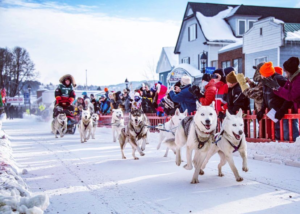
Literally thousands of residents lined the streets! The police met him on the outskirts of town and turned his return into a procession. The Lewiston High School Band marched before Moore’s cart, dressed in all-white uniforms. At the Lewiston Armory and Town Hall, he spoke to packed houses, and the Mayor presented him with the key to the City.

Teary-eyed, Moore began: “This is the day I’ve been looking forward to for a long, long time. But I never dreamed it would be quite like this. It is wonderful, really.”
“Would you be willing to repeat the trip?” a reporter asked.
“Not if you’d lay $200,000 right on this table,” answered the musher.