We recently received this question on our social media account. “After all,” one might argue “The average Iditarod team does 1,000 miles in 14 days and you are only traveling 750.” We expect our expedition to take 18 days at least. While the answer to why seems obvious to us, we realize that others who are unacquainted with expedition travel may have the same question, so we will take a moment to answer it here.
First we will compare our proposed 40-45 mile per day goal to past expeditions more generally. Then we will compare it to past Serum Run Expeditions specifically. Finally we will compare it to distance dog sled racing.
A century ago, explorers traveling by dogteam were elated if they accomplished 10-20 miles per day. And even then, they suffered the loss of many dogs and- often- men.
Why did they travel so slowly? Jumble ice. Overflow. Open water. Blinding blizzards. Breaking trail. Glare Ice. Staggering snow depths. Setting camp. Breaking camp. Caring for dogs and men. “But you have snow machines accompanying you!” So did Scott. “But you will have caches every 4 or 5 days!” So did Scott. And they all died.
On our expedition we will be dealing with all of these same hurtles. Unlike the great age of exploration, however, the loss of dogs or men is an unacceptable outcome.

“But haven’t there have been other commemorative serum runs on the same trail?” Yes. Most of them were led by polar explorer Norman Vaughn. They too had support machines and those commemorative expeditions also took approximately 18 days as did the subsequent runs. And Vaughn ran them a full month later than the actual anniversary date.
“So then what makes your expedition significant?”
In short- a lot. Past Serum Run Expeditions have started a full month after the actual January 27th anniversary date. The reason for the delay is simple. The conditions of the original Serum Run relay mushers were deadly dangerous. On the actual anniversary date we will be dealing with temperatures that are, on average, 20F colder than a month later and with 4 hours less daylight per day. So our goal to match past Serum run mileages with less daylight and more extreme temperatures is within itself a tall order.

“But didn’t the original serum run only take 6 days?”
Yes. but the original run was a relay of 20 teams. Most of these teams traveled no more than 30 miles and stayed in Roadhouses along the way. Most of the mushers were local to the portion of the trail they were to travel. They could push their dogs hard for 30 miles and then bring them into the roadhouses to warm them and then rest them for several days or retire them due to permanent injury. Also the trail was a well traveled and the primary route for people in those times. Our single dog teams will be traveling the entire route, from start to finish. We will not be changing out dogs or mushers. It is also important to note that, even to those local and veteran mail carrying mushers of a century ago, that relay from Nenana to Nome normally took 22 days for them, on familiar trails, at this extreme time of year.

The other reason past Serum Runs have wisely waited till the end of February is the “Iron Dog Race” and the “Iditarod Race.” The late February snowmobile race follows much of the same route as the Serum Run in mid February- thus blazing a trail for the Serum Run mushers. And once they got halfway into the Serum Run on the Iron Dog track they would pick up the marked and groomed Iditarod trail for the big March race. Conversely, local villagers and mushers are telling us that “We don’t even travel between villages that early in the season. We don’t put those trails between villages in until the middle of February.”

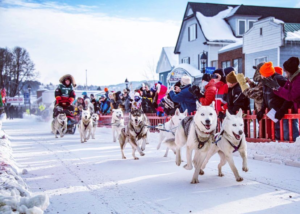
Finally, as I have noted elsewhere- those who would compare racing sled dogs to a dog sled expedition, make two mistakes. First, they underappreciate the massive effort that organizations like the Iditarod and Can-Am Crown put into making those record race time trails and warmly supplied checkpoints possible. In a race- you take more dogs than you need and drop them if they get injured or dont wish to go on then the race takes care of them. In order for every dog on our comparatively small teams to make it to Nome, we must ensure the health and wellbeing of every dog all the way to the end. Secondly- they underestimate the added difficulty of being a self sustained expedition team on virgin and unknown trails in extreme conditions. Races take on the responsibility of the trail conditions, and safety, and that the checkpoint supplies are ready for the teams. This is not to say that one is harder than the other. But they are very different experiences altogether.
Finally, we hope to connect the village school children along the way to connect them to the children of Maine. This will take some time.

In short, there are good reasons why the mushers who did this- in relay- a century ago in these conditions, were heroes. The conditions at this time of year in the interior low-arctic Alaska are not to be taken lightly. And there are good reasons why subsequent commemorative expeditions have waited a month later. While we will be starting on the anniversary date of January 27th- during that same extreme time of year, and will be doing the entire route in it’s entirety (spending most nights camped on the trail)- we will be thankful for the providence of making even an average 40 miles per day.

If you’ve enjoyed this article and want to help us make this expedition a success, we invite you to partner with us in sponsorship. You can do so by
–Sponsoring a dog
–Buying from our online store or
–Or giving a one time donation.
Thanks in advance for your partnership!