Discussions around genetic diversity in the Seppala Siberian Sleddog never truly begin or end; they simply permeate. Seppalas have never enjoyed the luxury of wide genetic berth to pull from in times of need, or when inbreeding depression starts to rear its ugly head. This is true of all purebreds but even more so of Seppalas, whose initial guiding breed principle was that dogs outside a specific set from the 1920s Poland Spring Kennel, even if considered Siberian by the AKC, were to be excluded. It sustained for a while – An awfully long time in fact, perhaps owing to the natural health and hardiness of the genetic base even when kept so tightly bred.
But nothing lasts so long as forever, and genetic health sooner or later becomes a concern for any small and vulnerable population. Since the late 20th Century, the Genetic Diversity question for Seppalas has not been \”Do we need it?\” – it has been \”From where, and how\”? Should we turn to landrace dogs, true to spirit but sometimes of enigmatic backgrounds, and with little official record of work proving? Or to Seeley-derived Racing Siberian Huskies, whose very absence has historically been the defining characteristic of the Seppala Siberian? Or differently still, to the elite racing Alaskan Huskies, heavily performance selected and with their purpose set in stone, but with an ever changing blended genetic makeup? And in all of these hypotheticals or others, the obstacles: Who will do the heavy lifting of coordinating, rearing, and proving these \”not-quite-Seppalas\”? If you\’re a believer in the Seppala-Wheeler philosophy, there seem to be no easy answers.

Some motivated Seppala devotees have attempted over the years to answer the questions of this problem, and addressed the situation hands-on by taking on Outcross projects. There are the Racing Siberian Husky (RSH) additions overseen by Douglas Willett and his kennel partners, introducing some Seeley-derived blood but keeping the \”purebred\” definition within Victorian-era standards for Seppalas (allowing AKC and Canadian KC registration of Seppalas as SH to continue). Then, there are the Solovyev-strain Russian imports incorporated by Jeffrey Bragg and Isa Boucher, joined in and carried on by their partners in Spain, Canada, and Alaska. Both men also attempted outcrosses to Alaskan Husky racing dogs, with self-admittedly mixed results; these Alaskan crosses have not survived in ISSSC Seppala Siberian Sleddog pedigrees today.
Now in 2024, the Sled Dog world is much different than it was even in the 1990s or early 2000s when these conversations were coming into the forefront of the Seppala community, much less the 1930s and earlier. But the Genetic Diversity question appears to ring the same: \”From where, and how\”?


With the 5-0 Board decision made in 2023 to close the Seppala Siberian Sleddog Studbook and implement a case-by-case Outcross review program, there is a pressing need for us to also recognize the resources already available. There is, just as there was with the Percentage-Based Purebred system, a difficult balance to strike. While managing Inbreeding Coefficients, if we are not judicious there is also a very real risk of adding so much \”diversity\” that we lose distinction; the very thing we find ourselves defending the existence of for Seppalas even still today. The work of Outcrossing has already been undertaken for multiple generations, decades even, of breeding. Outcrosses are monumental projects, with high investment and risk, and a potentially very narrow margin of reward.
It is my belief that while we work to mitigate Coefficients of Inbreeding (COIs) we should start to think critically about how effectively we are using those resources that are already incorporated into the Seppala gene pool.


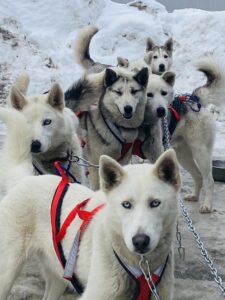
On September 22nd, 2022 a litter of two male and four female Seppala puppies was born; a litter representative of a reunion of Seppala Siberian Philosophies. Through great efforts, PSK Shiro of Snowy Owl, a Seppala stud of Canadian lineage with the Solovyev-Strain Russian outcrosses in his pedigree, was imported to Maine and sired Poland Spring\’s \”K-Litter\”. The dam, Poland Spring\’s Zoe of NL, was a purebred Seppala bitch of RSH-cross derived American Seppala bloodlines. In faith to the ISSSC\’s agreement to fully incorporate the Solovyev imports into the studbook, the litter are purebred Seppala Siberian Sleddogs, registered with the Continental Kennel Club as such.
Going forward, full disclosure is important here – The author of this article is an owner of one of the resulting K-Litter Seppalas. This does highlight my bias. But, it also means I am intimately familiar with the obstacles that such a reunion reveals.


One may wonder, with a reunion litter such as this, how much diversity is really promoted? And what traits do the Solovyev dogs in the background bring forward? Although the sire Shiro is tightly bred on a number of the Bragg Seppala Kennels\’ bloodlines, when bred to Zoe a 10-Generation pedigree analysis for the K-Litter estimates a ~12% Coefficient of Inbreeding. Tested with Embark, one K-Litter progeny returned a very comparable Genetic COI of 13%, as well as testing as 100% Siberian by Embark\’s ancestry panel. The litter is of quintessential Seppala type, and though young, are showing great promise in harness.


There is a cost to this reunion, though – it comes with a sense of urgency. Seppalas with these Canadian bloodlines and the carefully incorporated Solovyev Import lines, are aging. There are a handful only of breeding age, and they are scattered throughout Canada and the United States. As of now, they have not been well-incorporated back into the mainstream bloodlines common in the Lower 48, Europe, and elsewhere, despite their status in the studbook as Purebred Seppala Siberian Sleddogs. Human nature has often been the Seppala breed\’s enemy. Breed politics, points of convenience, and anxieties of the unknown often its agents. As the humans who have taken on stewarding the breed against these things, intention and conscious effort will be essential in preserving all of our genetic resources.


As mentioned before, the prospect of a litter such as the K-Litter is not without its obstacles. It is true that the K-Litter Seppalas and others like them are not eligible with the American or Canadian Kennel Clubs to be dual-registered as Siberian Huskies. For those who compete in Registered Northern Breed sprint races, this is a frustrating prospect – the major race organizations do not recognize the Continental KC Seppala Siberian as an arctic purebred as of this writing.
I myself have grappled with this very frustration directly. As a small team with limited resources, the best official venue for proving what Kismet is capable of would be sanctioned RNB sprint competition, but due to her pedigree we are relegated to the open category where recognition against other purebred teams is not measured. Recently, veterans of the ISSSC have reminded that club founder Doug Willett\’s vision for the future of Seppalas never lay in Purebred classes, but instead with success in Open class. This view is valid, as Willett himself proved, however the reality is that some 20-30 years on from that success, the Open class sprint scene is now very different. Ever-faster hound mixes dominate even the longer sprint events, many of the mid-distance stage races that Seppalas once struck success in no longer exist, and the costs associated with a large sized Distance kennel are harder to sustain. With sled dog racing getting shorter, smaller, tighter, the RNB sprint class is the most sensible venue for a majority of purebred racing mushers.
Though discussions are underway around finding a place for Continental KC Seppalas among their fellow arctic purebreds in the sprint racing scene, as of now there are no easy answers. Still, despite all of these obstacles, that sense of urgency remains; The window of opportunity to make use of the genetic resource of Solovyev-descended dogs and Bragg-derived bloodlines before they age out is small. In addition to an alternative outcross, these pedigrees contain numerous pure Markovo-Seppalas that have not contributed to Seppala bloodlines elsewhere. By the time their value is truly recognized against racing logistics, kennel club registrations, and purebred politics, they may very well be gone.

I will wrap up with a bold statement:
The importance of the breed\’s future should always outweigh the needs and conveniences of individual kennels and teams. To believe otherwise is to be an isolationist, which is something that the Seppala Siberian Sleddogs simply cannot afford.
While we make critical decisions regarding new Outcross opportunities for the Seppala, I look forward to the important and passionate discussions that will be necessary. But we must remember to give equal weight to the tremendous Outcross work that has already been championed, and is available to us in our gene pool. We owe it to the Seppalas of the future – our dogs\’ offspring, and the dogs of the next generation of mushers, not to overlook what is already in our grasp.


– Dimitrios Kapoukranidis, ISSSC Secretary