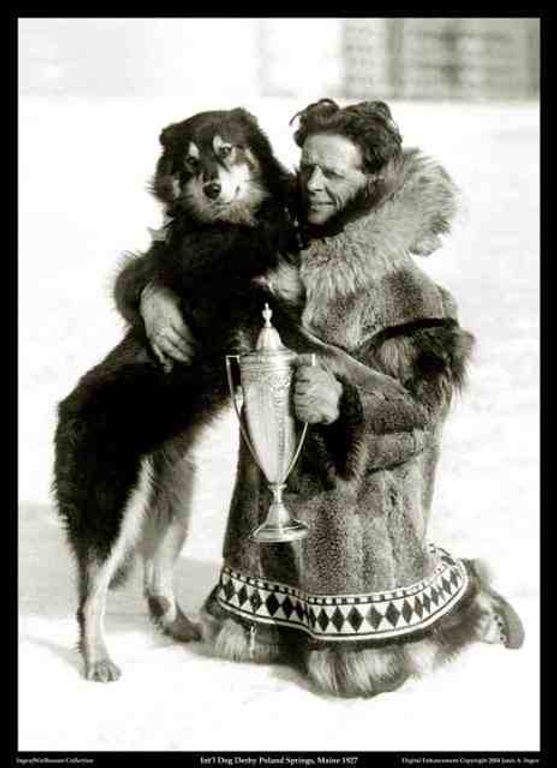
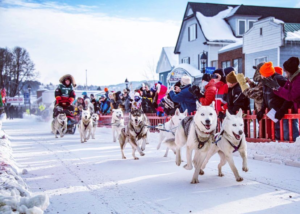
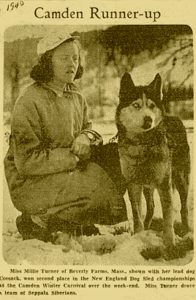
The first Poland Spring Carnival Race was held January 15–16, 1926. The race was known by several names in the Maine papers: the Poland Spring Sleddog Derby, the New England Dogsled Race, and the Maine Carnival Race. The race was judged and refereed by Dr. H. A. Souther of Brookville, Massachusetts, with the assistance of the race host, Mr. G. A. Ricker.
The race was a two-day, forty-mile event. Each musher was allowed a maximum of seven dogs on their team. The top three finishers would receive silver cups provided by the Ricker family, owners and operators of Poland Spring House, a large local hotel and resort. The race was to begin at 9 AM, with the first team leaving the starting line and another crossing every ten minutes thereafter. The first day’s course covered 18.5 miles on Friday the 15th, followed by a 21.5-mile course on Saturday the 16th. The second day’s starting lineup would be ordered by the first day’s fastest teams, with the winning team determined by the fastest combined time across both days.
The first day’s 18.5-mile course ran as follows: from the Ricker Mansion House to Poland, to Mechanic Falls, to Minot Corner, to East Poland, and back up the hill to the Mansion House.
The second day’s 21.5-mile course ran as follows: from the Ricker Mansion House to the Danville Electric Station following US Route 122, to the Hotel Road by way of Mansion’s Corner, to Littlefield’s in Auburn, to Mechanic Falls, to Minot Corner, to East Poland, and back to the Mansion House.
—
**The Stories**
Walter Channing — with his lead dog Smithy — joined Arthur Walden — with his lead dog Chinook — in Wonalancet, New Hampshire, and from there both men mushed their teams on the three-day trip to Poland Spring. Each man’s traveling team consisted of nine dogs.
All the dogs on Walden’s team were sons of Chinook, the only surviving offspring of the great Polaris — the lead dog that carried his team to the North Pole on the Peary Expedition. Both Channing and Walden planned to represent their teams later that season in the International Sled Dog Derby in Quebec. Each intended to run seven dogs in the Poland Spring Race, but Walden had to drop two of his after a “little free-for-all” broke out within his team before they arrived.
Edward Clark, another contestant, had only lived in New England a couple of years but brought considerable mushing experience. He had recently moved from northern Canada, where he had run a trap line for years by dog sled, bringing with him his “Pure Eskimo Dogs.” His team of ten dogs, led by “Sitty,” carried him the 80 miles from his home in New Hampshire to Poland Spring.
Originally two women from Cambridge, Massachusetts — Caryl Peabody and Clara Enebuske — were to compete. The week prior to the race, however, Mrs. Peabody strained a ligament in her knee and dropped out, hoping to recover in time for the New England Point to Point race that was approaching. She would factor significantly into the story of the second running of this race in 1927, though again not as a contestant.
Mrs. Enebuske’s team of six dogs, led by the beautiful long-coated Scamp, consisted entirely of sons of Walden’s Chinook.
The above-named contestants were thought to be the only entrants, but as dusk settled on the eve of the race, a team of dogs came up the hill toward the Mansion House and a man stepped off the back of the sled. In a thick French-Canadian accent he exclaimed, “Voilà!” Phillip Malloy of Berlin, New Hampshire, explained his late entrance this way: “I see Msieu Clark go pas y house dis morning with a dog team and I say to my wife, ‘By gar, I think I go to this race too!’ She says, all right, and so I go.” Malloy had carried mail by sled between Moissie and Eskimo Point in Labrador for years and was not a contestant to be taken lightly. His team of six Labrador Huskies was led by “Spring,” who resembled a slightly smaller version of Chinook.
**January 15th starting order:**
– 9:00 — Philip Malloy (team 4)
– 9:10 — Walter Channing (team 2)
– 9:20 — E. P. Clark (team 5)
– 9:30 — Clara Enebuske (team 3)
– 9:40 — Arthur Walden (team 1)
—
**The First Day**
The roads were bad. On the first day, Mrs. Clara Enebuske was the big story — although she finished last with a time of 4 hours, 13 minutes, and 50 seconds. She started the race with just five of her dogs for reasons unknown. Halfway around the course, one of her wheel dogs, “Michael,” went lame. “By all dictates of common sense, Mrs. Enebuske ought to have quit right there,” exclaimed one reporter. She persevered, finishing with four dogs and Michael on a leash. She received a big round of applause for not quitting, and “even the dining room guests crowded the windows to watch her come in,” the report noted.
“Well, I’m here,” she sighed.
“Tough luck, Mrs. Enebuske — will you be racing tomorrow?”
“Tomorrow? I’ll race tomorrow with two dogs if I have to.”
Walden, on the other hand, finished the 18.5 miles in 1 hour, 49 minutes, and 30 seconds — better, it was noted, than the average at the Eastern International Derby in Quebec the previous year, which Walden had won in 1921 with a younger Chinook.
Walter Channing finished 2nd with a time of 1 hour and 57 minutes, crossing the finish at 11:07. Responding to a request at the finish to pose his dogs for the photographer, a “free-for-all broke out,” started by his huge black wheel dog Jack — who had a good deal of Newfoundland in him, it was noted. Jack had to be clubbed from his perch on a teammate’s throat.
Clark finished 3rd with a time of 2 hours and 12 minutes. He lost four minutes at the start when his team tried to return to the barn. His obedient lead dog Smitty swung them right, the sled flipped, Clark’s leg got caught, and he was dragged several feet. While others untangled him, his team broke into a fight — reporters noted they had each other’s fur in their mouths as they were pulled apart.
Malloy finished 4th on day one with a time of 2 hours, 20 minutes, and 10 seconds. He ran a six-dog team led by his leader, Prince. Three of his dogs were very young and finished the race “crawling back exhausted.”
Friday night, after the first day’s race, Arthur Walden was awakened by Chinook, who “swept Walden’s bedclothes off.” Chinook and Walden went out to the stables where the other dogs were kept and found Chinook’s son Koltag — who would be replacing Chinook at the Internationals in Quebec — choking to death on his own lead chain. He had climbed on a bale of hay, gotten wrapped around a post, and when he jumped off, the struggling tightened the chain. “How Chinook knew is a mystery.”
—
**The Second Day**
Although not much is yet known about the second day, the second-day starting order was as follows:
– 9:00 — Arthur Walden
– 9:10 — Walter Channing
– 9:20 — E. P. Clark
– 9:30 — Philip Malloy
– 9:40 — Clara Enebuske
**The Winner**
Arthur Walden won the first running of the Poland Spring Sled Dog Race with an unofficial world record of 40 miles in 4 hours, 1 minute, and 55 seconds — approximately 10 miles per hour.
*(Article by Jonathan Nathaniel Hayes)*
—
**1927 Poland Spring Derby**
Poland Spring, Maine’s second Carnival Race was held Friday, January 27, 1927.
The race judges were: Dr. Harry A. Souther, Vice President of the New England Sled Dog Club and official starter and timekeeper; Herbert J. Pearson, State Humane Agent; and E. P. Ricker.
**East Meets West**
Prior to this historic race, it was widely assumed that the western “Siberian-type dogs, frequently crossbred to wolves,” would stand little chance against the larger mongrels of the East, bred largely from dogs brought down from Labrador and beyond. When this theory was presented to Leonhard Seppala before the race, his only response was that he hoped for cold weather on account of his dogs’ heavy fur, and that he would have liked more time to prepare his team — they had spent the past several months doing little more than being on exhibit across the country.
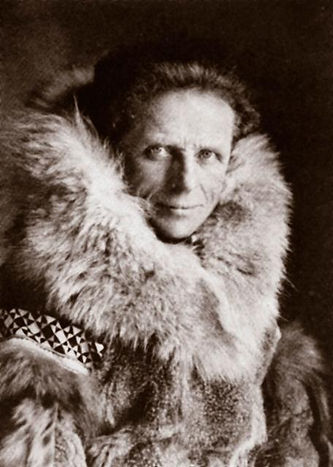
*Seppala — photograph property of Jonathan Hayes*
The Thursday prior to the race, five teams were reported registered and ready. “Seppala,” as his name was misspelled in the article, “has two teams entered in the race.”
By Friday morning, seven teams had readied themselves for the first day’s 25-mile leg.
The famed adventurer and New Hampshire resident Arthur Walden had entered the race with his celebrated lead dog Chinook, who was registered in the Mansion House with him — the other dogs stayed in the barns, of course. Walden was the favorite, as last year’s winner with a well-established knack for winning New England Sled Dog Club races. Many of the region’s mushers ran dogs sired by his Chinook.
Walter Channing, a serious musher and second-place finisher in the previous year’s race, was also entered.
E. P. Clark, the 1926 third-place finisher, did not enter — he and the Minot, Maine postmaster Alden Pulsifer were delivering gifts from the Governor of Maine to New York’s Governor Smith and Albany’s Mayor Thatcher by dog sled team.
The race was to begin at 9:30 AM, with teams leaving in ten-minute intervals.
The original course was planned as follows: from Poland they would mush to Dry Mills; from Dry Mills to West Poland; leaving West Poland, the teams would follow the shoreline of Lake Tripp to Poland Corner and back to Poland Spring.
However, after the course was inspected, a last-minute change was made due to a great deal of broken ice on the roads. The actual course ran as follows: mushers started at the Mansion House in Poland Spring, traveled through the Shaker Village and past Sabbath Day Lake to Dry Mills, turned right onto North Raymond, passed Churchill’s Store to West Poland, followed the shore of Lake Tripp, turned onto the state highway above Poland Corner, and finished in front of the Ricker Inn, 200 yards below the Mansion House.
As the race commenced, the temperature rose from the single digits to well above freezing. Strong gusts of wind, however, helped keep the dogs from overheating. Before the race, while temperatures were still bitterly cold, one newspaper recorded this exchange:
“Not enough sting in it,” Seppala told a shivering reporter. “Want it good and cold.”
Walden’s team, however, had been bred in this country and was fully acclimated. This was their weather. Leonhard Seppala would later comment to reporters that it was too warm for his heavy-coated Siberians.
Seppala left the starting chute at 10:20 and encountered two significant delays during the race.
At the start, his team twice broke for the barn where they had been quartered, and he had to wrestle them back to the course — a delay that cost him at least two or three minutes according to reporters.
The second delay went unreported by Seppala after he crossed the finish line and remained unknown until Elizabeth Ricker crossed the finish at 2 PM. She told everyone present that Seppala had caught up to her on the trail, and that she had given her lead dog Sport the command to lead her four-dog Chinook team off the trail to give way for Seppala’s Siberians. Her team got tangled and began to fight. Seppala, seeing her distress, left his own team loose and unattended and went to her aid.
After the race on Friday, the headlines read: “Alaska Dog Driver, Hero of Race at Poland Spring.”
Seppala’s time would surely have been four to five minutes faster had he not encountered these two delays — and displayed such admirable sportsmanship on the trail.
Elizabeth Ricker herself had yet another incident during the race. She was taking a break and eating a sandwich when her four large Chinooks caught sight of a skunk and bolted off the trail after the creature.
Seppala’s time from the 10:20 start to crossing the finish line 25 miles later at 12:31 PM had experts calculating he had traveled at approximately 11 miles per hour.
Arthur Walden left the Mansion House starting line at exactly 10:30 AM and finished at 12:48 PM. Although Walden had Seppala in his sights twice during the race — due to Seppala’s hold-ups — Seppala kept pulling further and further away. Walden never caught the Alaskan musher.
Walter Channing, with his lead dog Tom, came in 3rd, averaging 10 miles per hour — a pace that was “usually taken for granted would win any dog race under similar circumstances.”
George Constable also posted a strong time despite crossing the finish line with two dogs running loose rather than in harness.
Togo did not run on Seppala’s main team due to his age, but led the team of the Alaska Native musher Kingkeah — whose name reporters mangled repeatedly in print as Kingeah, Kingea, Kingkea, and Kingkeak. Kingkeah and Togo would finish the day in 6th place.
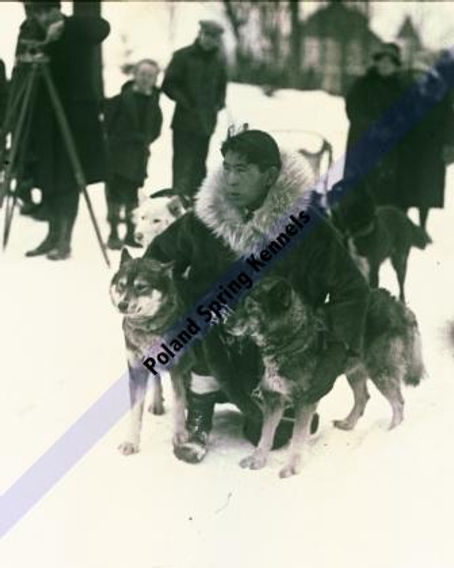
*Kingkeah with Togo at the Poland Spring Derby — photograph property of Jonathan Hayes*
Despite the multiple setbacks, the warm temperatures, and the lack of conditioning, Seppala’s team of small Siberians won the day.
**Day One Results:**
– 1st Place — 2 hrs. 11 min. — Leonhard Seppala
– 2nd Place — 2 hrs. 18 min. — Arthur Walden
– 3rd Place — 2 hrs. 27 min. — Walter Channing
– 4th Place — 2 hrs. 28 min. — George Constable / Canadian (for owner Mosely Taylor)
– 5th Place — 3 hrs. 3 min. — Bragdon MacGregor (for Walter Channing’s puppy team)
– 6th Place — 3 hrs. 8 min. — Kingkeah (for Seppala)
– 7th Place — 4 hrs. — E. P. Ricker Jr.
To appreciate how fast these teams were racing, the previous 25-mile record — or “World Mark,” as reporters called it — was held by Canadian musher Emile St. Goddard, who had run 25 miles in 2:22:30. Two teams in this race beat that world record outright (Leonhard Seppala and Arthur Walden), and two others (Walter Channing and George Constable) came within six minutes of it.
After the first day of racing, those who had preferred the eastern dogs swung completely the other way. Mushers and would-be mushers lined up to speak with Seppala about acquiring dogs from him.
Despite Seppala’s team having overcome considerable obstacles, one reporter — not quite willing to concede the Siberians’ superiority — added this addendum to his account:
*”However, due allowance had to be made for the skillful handling of Leonhard Seppala… His knack of giving a push with his foot from time to time in perfect rhythm on the level was a contributing factor… also aided by pushing the sled with his wiry strength on the upgrades. He would paddle with alternating feet — this was one of the little tricks he used. There were others.”*
Mrs. Caryl Peabody — the same Mrs. Peabody who had dropped out of the 1926 race with a leg injury — negotiated for the purchase of a team of Seppala’s Siberian Huskies. One reporter noted: “Friday it was pretty well understood that Mrs. Peabody would have the team, part of which would be made up of dogs used in the race here, with two puppies to be shipped from Alaska.” She also negotiated the purchase of Seppala’s beautiful fur parka.
At the finish line on Friday, Seppala was asked, “How old are you?”
“Me?” he replied. “I’m 55. But I’m 20 in spirits!” And to prove it, he did three handsprings in succession.
“And I’ve got a wife and three children!” he added, walking over to give Togo a pat on the head.
One reporter noted: Seppala would sell his other dogs — but not Togo.
Later that evening, Seppala brought Togo into the Mansion parlor to tell “the kiddies and grown-ups, too, the story of the dog from his birth to the present.”
Friday night and Saturday morning it rained. When the rain froze, it turned the trail to glare ice.
The second leg of the race was postponed Saturday morning over the weekend — there would be no racing on Sunday — in the hopes that conditions would improve by Monday. The big news for reporters that Saturday was Seppala’s announcement that the eleven-year-old Togo would be staying with Elizabeth P. Ricker Jr. — a complete reversal from his statement the day before, when he had told Mrs. Peabody he would not sell Togo for the world.
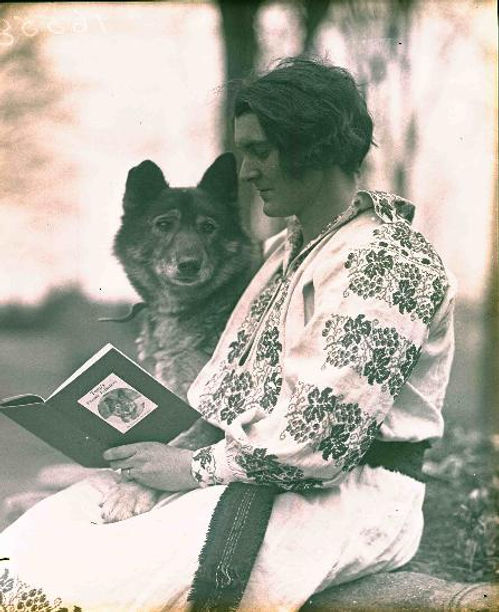
*Elizabeth Ricker and Togo — photograph property of Jonathan Hayes*
On Monday the 30th of January, the judges ruled that the remainder of the race would have to be canceled due to poor conditions. The Silver Cup was awarded to Leonhard Seppala and his lead dog Billiken in front of the Ricker Inn in Poland Spring.