Ascending great summits by dog team is a long-standing tradition in history.
In 1926, Arthur Walden and his team of Chinooks summited New England’s tallest mountain — Mount Washington. Walden was appointed lead musher on the Byrd Antarctic Expedition the following year. A handful of mushers have since repeated the feat, including the most recent dog team ascent of Washington in 2017.
In 1979, the legendary Joe Reddington Sr. and Susan Butcher summited Alaska’s Mount Denali — the tallest mountain on the North American continent — by dog team. Although it is a national park, a handful of mushers have replicated this ascent since.

*Joe Reddington and Susan Butcher summiting Denali — North America’s tallest peak.*
Mount Katahdin, Maine’s tallest mountain and the first spot in North America to catch the rays of the rising sun, has never been ascended by dog team. While it may not be as tall as Mount Washington, it is steeper — in fact, it is the steepest ascent along all 2,200 miles of the Appalachian Trail.
“It has not been done because it cannot be done,” some have argued. “No dogs have been allowed in that park since Governor Baxter created it in 1931.”

*Katahdin rising into the clouds some 30 miles distant*
What if I told you that draft animals were used in the park after its inception? What if I told you that many people enjoyed the park with their dogs in its early years — including Governor Baxter himself? What if I told you there was a sanctioned and highly publicized dog sled attempt on Mount Katahdin during the park founder’s lifetime, and with his knowledge? What if I told you a dog team has already been on that mountain?
“It never happened,” I have been told by people who should know.
But it did.
**Chinooks on Katahdin**
In 1951, Maine Guide and world-champion woodcutter Perry Greene, eight Chinook sled dogs, and seven Boy Scouts — yes, you read that right, Boy Scouts — attempted a winter ascent of Katahdin by dog team. The day prior, on March 15, 1951, they came within 9 miles of the mountain by way of Togue Pond, where they set up base camp for a push on the mountain the following day. Greene planned to summit by ascending the Roaring Brook Trail to Chimney Pond, then continuing up the Saddle Trail.

*Perry Greene, his team of Chinooks, and a Waldoboro, Maine Boy Scout troop*
It is hard to fathom in an age when we try to childproof the world rather than world-proof our children, but theirs was not the only winter summit attempt by a group of boys that day. Another group of seven students from the prestigious Phillips Exeter Academy of New Hampshire had coordinated with Greene’s team to attempt the same summit by the same route on the same day. The Exeter team used cross-country skis, with the plan that they would break trail and Greene’s dog team and party would follow with gear and supplies.
On the morning of the ascent — Thursday, March 16, 1951 — all went according to plan until the parties came within 1,000 feet of the summit. With a sudden thunder, a large snow slide carried the Exeter team several hundred feet down the Saddle. Remarkably, all were relatively unscathed with one exception: Richard Greene of Leavenworth, Washington, was bleeding heavily from several wounds.
The Boy Scouts, under the direction of their scoutmaster Perry Greene, kept their heads and set about dressing the young man’s wounds. Perry turned his team of Chinooks around, loaded Richard and a companion into the sled, and left his Boy Scouts with the remaining Exeter students to make their way back down the mountain. He then drove his team the nine or ten miles back to the Togue Pond base camp.
With the added weight of two passengers, Greene’s sled broke a runner on the descent of the Saddle Trail before reaching Chimney Pond. Somehow his dogs managed to pull the entire remaining distance to Togue Pond despite the broken sled. That feat of strength notwithstanding, Greene realized he would have to abandon his summit bid — and years of planning — at least for that season.
In August of the same year, Greene told a Lewiston Daily Sun reporter that he believed he and his team would have made the summit. He added, however, that he and his scout troop had no regrets — they were simply glad to have been on the scene, with their scout training, to assist the Exeter Academy students.
By that time Perry Greene was already in his late 50s. Although he desired to make another dog sled bid for the summit, he was never able to get the logistics in place before age had taken its toll on both him and his team of Chinooks.

*Perry Greene and his Chinook leader*
Recently I was sharing my dream of ascending Katahdin by dog team with my mentor — retired Maine musher, Yukon Quest veteran, and Can-Am Crown International Sled Dog Race champion Don Hibbs. Hibbs told me he had himself written a request to Baxter State Park for a dog team summit in the 1980s, and had been denied.
**Will Seppala Siberian Sleddogs Meet Pamola?**
Native Americans believed the summit of Katahdin — which means “greatest mountain” — is home to Pamola, their god who is part man, part moose, and part eagle. It has been a dream of mine for over a decade to take Maine’s heritage breed of sled dog, a heritage that came to us through the native peoples of North America, to meet him.
Over the past decade I have requested a special dispensation from the park for a dog sled ascent of Katahdin on two occasions. The first time I was told that no one had ever attempted it and that it could not be done. The last park director, Eben Sypitkowski, was kind enough to consider my proposal. He agreed that a dog team could make the summit via the route I laid out, and referred to my goal as a worthy endeavor, commending the work I am doing to preserve Maine’s working breed of sled dog. But he too ultimately denied the request, citing the park rule banning pets of any kind.
Recently, my son was honored by Governor Janet Mills on her social media accounts, touted as a hero for saving his dog team from a rampaging moose. We had the honor of meeting the Governor at dinner during this year’s Can-Am Crown Sled Dog Race, and I shared this vision with her. Baxter State Park was in the process of selecting a new director, and Governor Mills graciously agreed to review my proposed expedition and share it with those who would ultimately make the decision.

*Maine Governor Janet Mills poses for a picture with Caleb Hayes*
I would therefore like to lay out my proposal to the Governor, to the future park director, and to the public, in the hope that I will be granted permission from the state.
**Why Do This Expedition?**
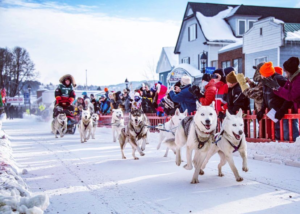
Maine has a mushing history second only to Alaska.
Polar explorer Robert Peary was a Bowdoin graduate and resident of Maine. He secured the glory of “First to the North Pole” for our country by dog team in 1909, launching that expedition from his coastal home here in Maine.

*Maine resident and polar explorer Robert Peary and his dogs*
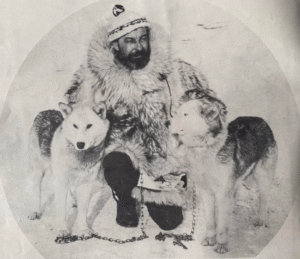
Arthur Walden and his Chinooks were an annual fixture in Maine races in the 1920s before he was selected as lead musher on the Byrd Antarctic Expedition. His kennel was carried on by Perry Greene here in Maine for decades.

*Arthur Walden and Chinook*
Famed Alaskan musher and hero of the 1925 Nome Serum Run, Leonhard Seppala moved to Maine with Togo and his team of Siberians to live and race here. Our endangered heritage breed of Seppala Siberian Sleddogs is descended from those dogs Seppala brought to Maine one hundred years ago.

*Seppala and Togo in Maine*
This Katahdin Expedition would serve to further enrich Maine’s mushing legacy and bring attention to its cultural significance to our state.
**How Would It Be Done?**
Having summited Katahdin six times via four different routes, I believe Greene’s use of the Saddle Trail was not the best approach for a dog team — though perhaps it was the only option available to him in the early 1950s. There is a safer, albeit longer, route.
I propose a three-day expedition. On day one, we would mush to Russell Pond as our base camp. Day two would be the summit attempt, approaching from the north in a southerly direction via the longer and less steep North Peaks Trail, crossing Hamlin Peak and continuing on to Baxter Peak.

*Map of Mount Katahdin trails*
I would organize an advance ski and snowshoe party of four to arrive at Russell Pond the day before us. That team would summit Katahdin the day before our attempt using the route described above, so that some form of broken trail would exist. Even if it were covered by snowdrift overnight, the prior day’s traverse would still be felt underfoot by the lead dogs.
My own team would consist of myself, four to seven Seppala Siberian Sleddogs, and two to three other fit companions.
**By Whom Would This Be Accomplished?**
I am a former cold-weather infantry Marine with over twenty years of mushing experience. Last winter I completed a solo 285-mile expedition across the North Woods. As a biologist who has studied conservation management at the graduate level, I am aware of and sensitive to the ecological concerns of the park. I am also a life science teacher for both middle and high school. I believe I am well suited to spearhead this expedition.

*Jonathan Hayes and his leaders, Frost and Bear*
I will not yet speculate on the other party members, but I have received commitments from prospective team members who include mountaineers, guides, and special forces military — all passionate friends of Baxter Park.
**Possible Objections**
I have heard several objections to this proposed expedition over the past several years and would like to address each of them here.
*”The park allows no pets of any kind.”*
To this I offer four points:
1. The park has previously permitted a summit attempt by dog team.
2. These are not pets but draft and working animals — a very real distinction.
3. This is not an attempt to overturn the park’s rule concerning pets, only to seek a one-time dispensation for a working team.
4. Denali National Park also has a no-pets policy, but differentiates between pets and sled dogs just as I have argued here. Denali park rangers conduct winter patrols by dog team, and dog teams are permitted on the park’s winter roads just as snowmobiles are permitted in Baxter.
*”It would not be in keeping with Percival Baxter’s wishes.”*
To this I would offer the following:
1. Percival Baxter had already formed the park and was only 65 years old when Perry Greene made his dog team attempt. Not only was he aware of the attempt, he was a personal friend of Perry Greene and gave his support to the dog sled expedition on Katahdin.
2. Many draft and working animals were permitted in the park — including Governor Baxter’s own pets — for years following its creation.

*Governor Baxter, founder of Baxter State Park, preferred his portraits be taken with his dogs.*
*”The dog team could contaminate the park’s fragile environment.”*
Of all possible objections, this is the most weighty in my mind. In response, I offer the following:
1. All team dogs will be fully up to date on vaccinations and preventative parasite medications, and health certificates for each dog will be presented to the park. There is therefore a greater chance of the team contracting something from the park’s wild animals than the other way around.
2. The winter’s sub-zero temperatures will further reduce any possibility of transmission.
3. Wild animals do not recognize the park’s boundaries. The national lands just outside its borders permit pets, and the ecology of the Katahdin region is already routinely visited by dogs that have not been screened or required to show health certification as our team will be.
4. In the arctic environment of the Tableland and throughout the park, we will confine all movement to designated trails. Any feed or feces will be bagged and carried out of the park with us.
5. In my view, the park already receives far greater disturbance from the noise and exhaust pollution of snowmobiles, which are permitted passage through the park. I am not opposed to snowmobiles using the park — but a one-time, park-monitored expedition led by a veterinarian-cleared dog team and a life science teacher trained to value and appreciate the unique ecology of this region is far more ecologically sound than what the park already permits on a daily basis.

**Conclusion**
To Governor Mills — thank you once again for agreeing to review this proposal and pass it on to the appropriate parties.
To the next Park Director — I ask you to look past perceived park customs and consider the history and points I have laid out above. Thank you in advance for your kind and thoughtful consideration.
To the general public — I ask that you help keep Maine’s mushing legacy alive and in the forefront of our citizens’ minds and hearts by supporting this proposal in any way you can.
Semper Fidelis,
Jonathan Nathaniel Hayes
MushMaine.com
207-728-5997
—
*P.S. — Perry Greene’s grandson, Peter Richards Sr., called me on May 4th, 2022. Now in his late 80s, he was one of the Boy Scouts on his grandfather’s team during the Katahdin attempt. He noted that Perry Greene was a well-known figure in Maine in his time and a close personal friend of Percival Baxter. He went on to confirm that Baxter himself had approved the mushing attempt on the summit — making the argument that “a dog team summit would not be in keeping with Governor Baxter’s vision for the park” entirely moot.*