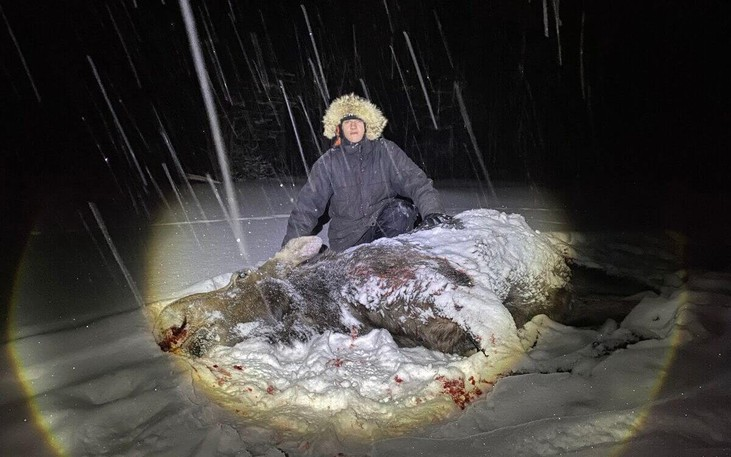
We were wrapping up our final training run of the season in a snowstorm, just two nights before the big race. Caleb was running our eight-dog team. We only ran 20 miles on this final run — the dogs were peaking and we wanted to keep it that way leading into the Can-Am Crown International Sled Dog Race. I was spotting traffic for him at road intersections from our old 1980s Bombardier snowmobile. We crossed our last road two miles from our remote winter training camp, so I set out ahead to prep the dog food back at the kennel. It was snowing hard. We had work and school the next morning, and it was already about 9 PM.
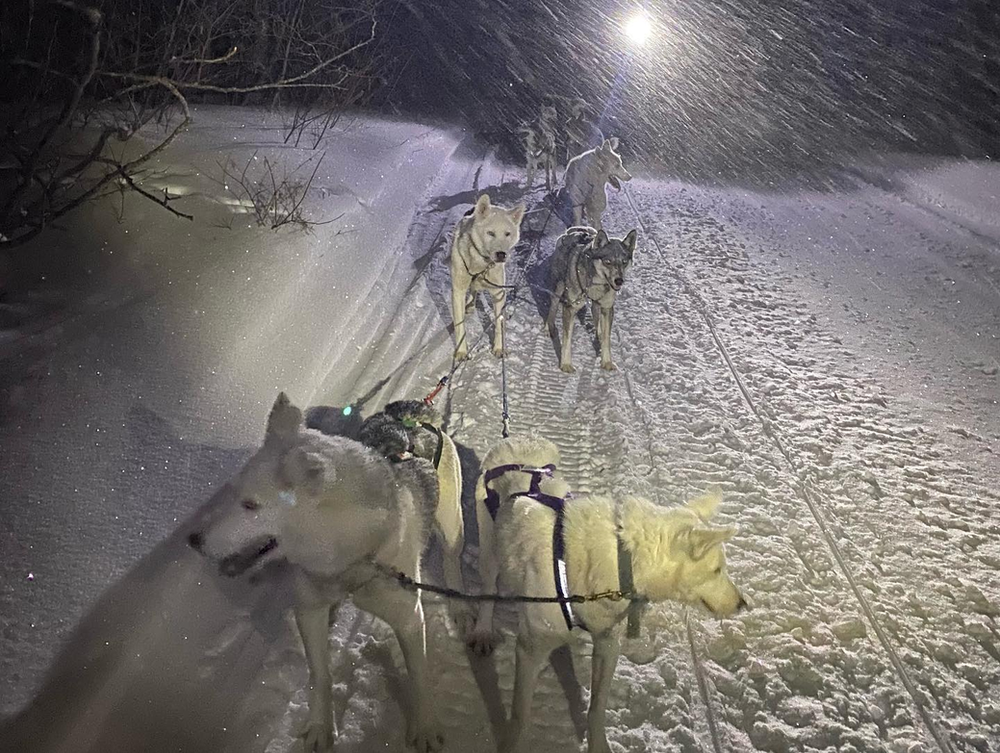
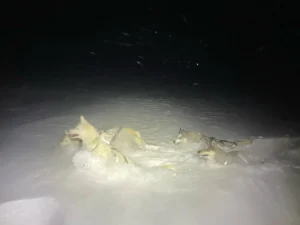
*Dog team in snow*
When I turned off the Interstate Trail System onto our 1.5-mile private trail back to camp, I noticed moose tracks in the trail. They had not been there when we set out two hours earlier. My outgoing sled tracks had already been covered by a fresh blanket of snow — but not these moose tracks. They were fresh. I hit the throttle, hoping to scare the moose off the trail ahead of Caleb and the team.
It had been a hard winter for moose. Without natural predators to help reduce parasites, invasive ticks from the south are wreaking havoc on our moose population. Moose are not what we in the wildlife biology field call “obligatory groomers.” Deer evolved in the south, where ticks and other external parasites require that they groom their coats to rid themselves of pests. Moose do not have that behavioral adaptation. Add to the parasites a deep snowfall crusted by an inch of ice, and moose were resorting to packed trails and roads to conserve energy — which unfortunately means more human-moose interactions.
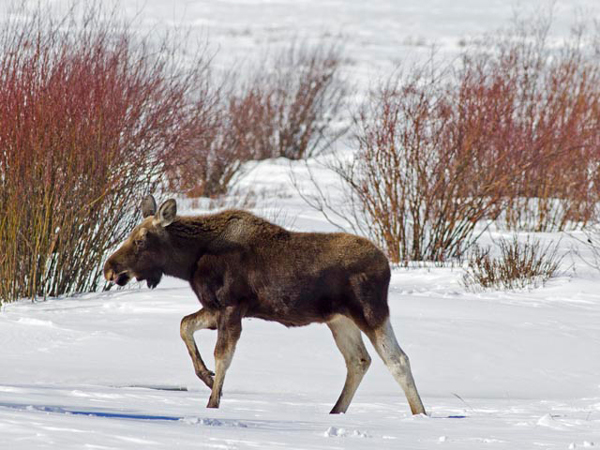
*Moose in snow*
This moose had visited our kennel only a few days prior. On that occasion I arrived from my day job as a school teacher and found tracks all down the center of our dog yard. I also noticed the moose had snapped our lead dog Vodka’s chain, and she was missing. After tracking her for only a quarter mile, it became clear she was running the moose off our land. I caught up with the pair a mile down the trail — Vodka nipping at the moose’s heels to keep her moving. It was a lone cow, a fully mature moose weighing around 750 pounds and standing roughly seven feet tall at the shoulders. I had to come within 12 feet of her to catch my dog — closer than I ever wanted to be to a moose again. I certainly prayed she would never return to our kennel.
Despite this, I was not carrying a firearm on the night of what followed. I used to. But after twenty-plus years of never needing one, I had grown lax. Sure, I had read the stories of moose decimating dog teams — that same weekend, an Iditarod competitor had to shoot one to save his team from an angry moose. And I went out without a cell phone. I almost always carry one on the trail, but when I realized I’d forgotten it at the dog yard, I thought, “One run without a cell phone. I won’t need it.” Same reasoning as the firearm.
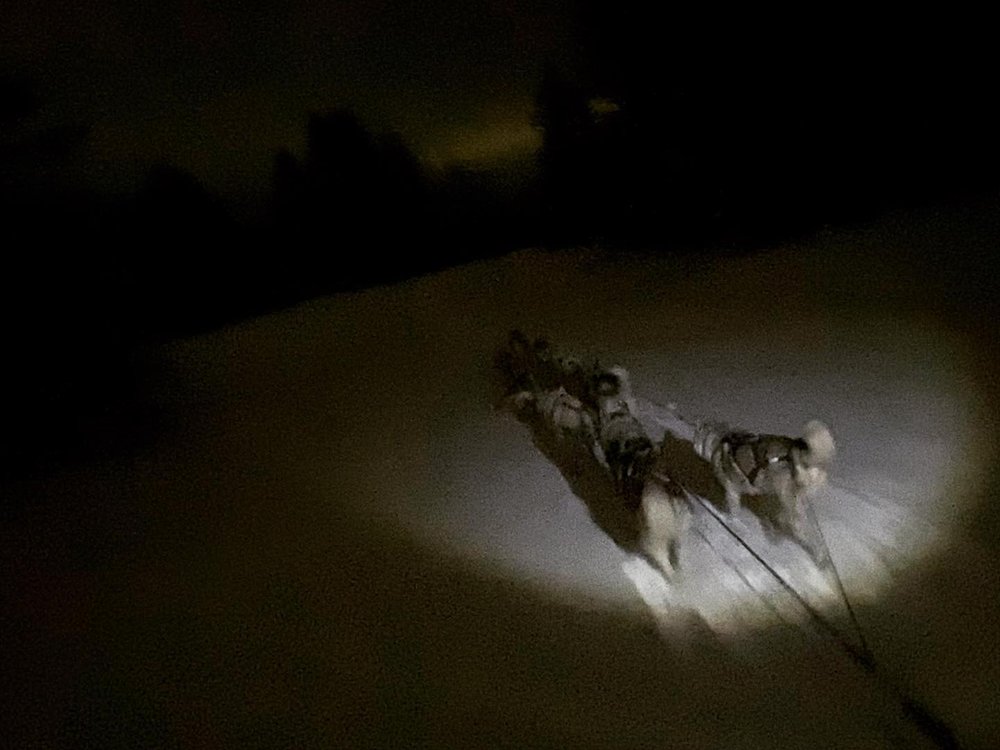
*Running at night*
This time, the moose’s tracks were heading straight into the dog yard rather than away from it. I hoped to catch up with her before she reached camp — we had puppies too young for the team tethered there. But at last I came around the curve in the trail just before camp and saw steaming moose droppings in the snow. Her tracks led in. None led out. I had to warn Caleb.
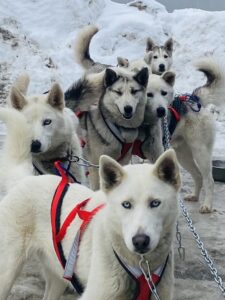
Within a few minutes Caleb pulled up beside me with his fresh team of eight Seppala Siberians. Caleb was 17 years old and training for his first mid-distance race of 100 miles.
“Be careful,” I warned. “These moose tracks are fresh — she’s likely in the dog yard again.”
“Yes sir,” Caleb said, and let off the brake. His team charged around the bend toward camp.
It took a few pulls to restart the old Bombardier, but I was only about 60 seconds behind Caleb as he entered camp. As I approached, I noticed he had stopped the team short of the dog yard. The dogs were growling, barking, and slamming their harnesses. I had not yet reached him when his extra-bright headlamp shone through the falling snow onto what had stopped him. There she was — charging the puppies and stomping on dog houses.
I knew it wouldn’t be long before she turned her anger from the pups to Caleb’s raging team. In the mind of a moose, there is no difference between a dog team and her primal adversary — a pack of wolves. So I throttled the snowmobile and put myself between the team and the moose, bringing me to within 20 feet of her.
I shone the headlight at her. I revved the motor. I yelled — all in hopes she would run. But this moose was in a rage of desperation. Was it the straw bedding of the dog houses and her starvation that drove her to make the dangerous choice of entering a “wolf yard” a second time? I will never know for sure. But my antics did not scare her. They seemed to make her angrier.
She charged me. I scrambled backward as she came right over the snowmobile. I tripped and fell. I turned skyward from the ground to see an image that will stay with me forever. She stood over me, ears pinned back and eyes bulging in a mix of rage, desperation, and fear — as if she couldn’t decide which was driving her. I learned in that moment that moose are capable of growling. A low rumble rose from deep within her. There I lay on the ground before her. There she stood over me — a magnificent monster.
All this while, Caleb had kicked both snow hooks into the ground and moved up to the middle of his team to hold the gangline. He had also unclipped the tug lines from a few harnesses to reduce the team’s pulling power — brilliant thinking, as the dogs wanted nothing more than to engage the moose.
But in the moment the moose stood over me, Caleb’s team of Seppalas overpowered him. They pulled both snow hooks and began dragging Caleb, the sled, and the hooks straight toward the rampaging moose.
In retrospect, I believe the dogs multiplied their efforts because they saw the moose attack me. Who knows what she would have done — but I believe they were trying to save my life. In doing so, they were unwittingly endangering Caleb’s.
Although he is only a teenager, Caleb is a true musher, and his first thoughts were for the safety of his team. He refused to let go of the gangline. The team dragged him to the moose’s deadly hooves.
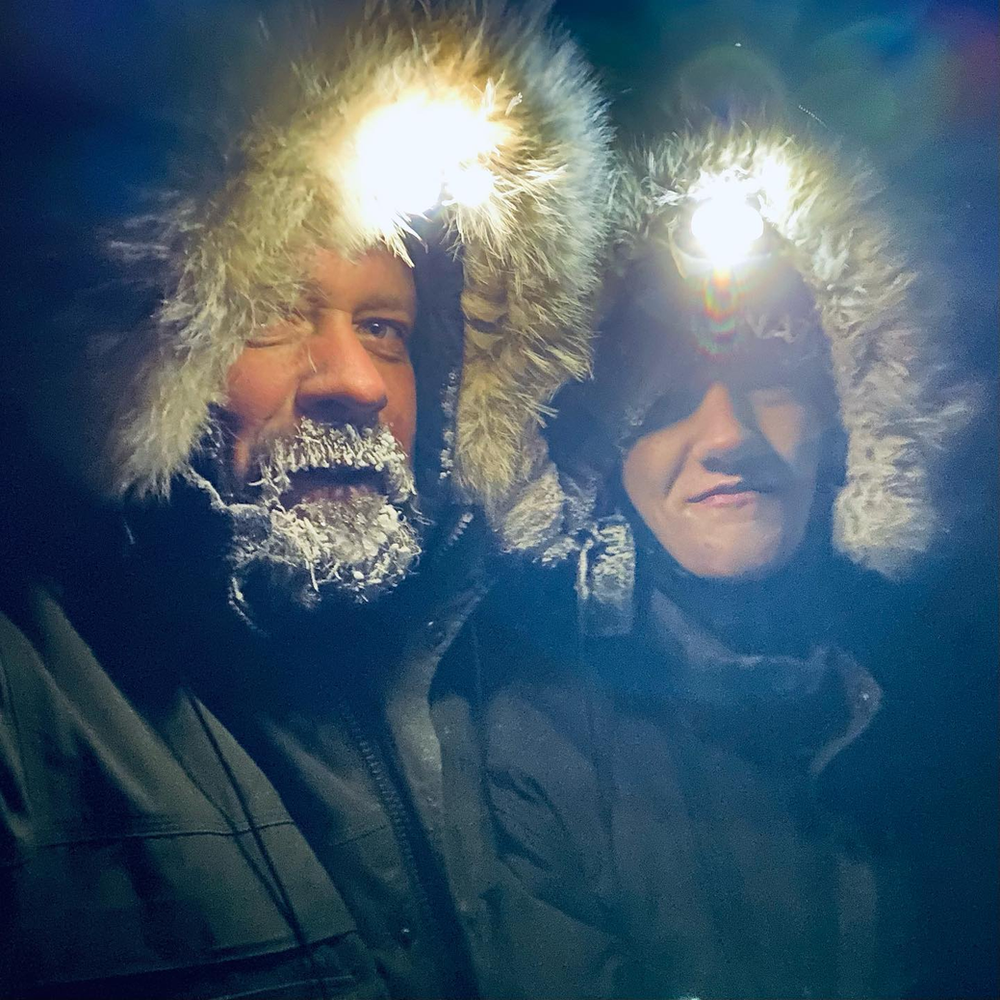
*Father and son*
This diverted her gaze from me to the dogs. She charged Caleb’s team.
“Caleb! Get out of there!” I yelled as she stomped and kicked her way down the team toward him. He obediently released the gangline, but it was too late — his foot was caught in the tangle of gang lines and tug lines. The moose was so focused on striking the snarling “wolves” with her hooves that she passed right over Caleb as though he wasn’t there. When she reached the sled she turned and worked her way back down the team.
As soon as she made it to the front of the team, Caleb and I grabbed the gangline and pulled all eight dogs backward through the deep snow, foot by foot, until we reached a packed portion of the dog yard.
“Why wouldn’t she just run off through the woods?” you might ask. In the mind of a moose, a pack of wolves would have the upper hand if she plunged into chest-deep, ice-crusted snow — that is how wolves overcome their prey in winter. Wolves run easily atop the crust of ice while their heavier, hooved prey sinks and founders. So the only route out of our kennel she would accept was the one we and our dogs stood on. We would gladly have given it to her. But there was something else to her motives, something else in her eyes that I won’t pretend to understand. Several times during our 45-minute standoff she made her way through the team to the outgoing side of the dog yard — and each time she turned and worked over the team again rather than take her leave.
My mind raced for solutions. Release the dogs? They would charge her incessantly and surely be injured. They might run her out of camp, but I’d have several loose dogs on the chase — and she would just return. This was, after all, the second time in one week she had come causing havoc. As she turned her wrath once again on the tethered pups, I knew what had to be done.
“Caleb, hold the dogs. I’m going to try to restart the snowmobile.”
The old Bombardier had stalled and was quirky to get running again. This would take me closer to the moose. We’d been keeping the machine between us and her, but it was no deterrent now that it wasn’t running.
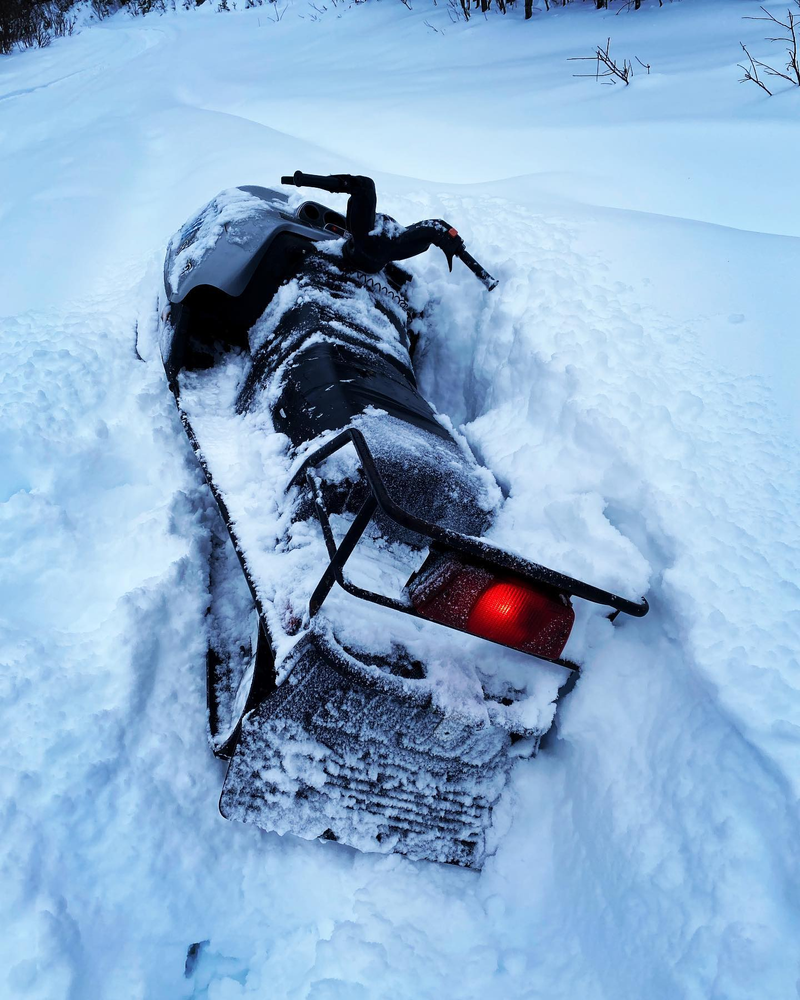
*Our old sled gets stuck… often*
“Once I get it running, I’ll come back for the dogs. You hop on and drive to the nearest road. Go to the nearest house and ask for a rifle.”
It was the only logical plan. I’m bigger and stronger and can hold the dogs more easily — and there was no way on earth I was riding off into the sunset and leaving my son alone with a mad moose and eight straining sled dogs.
Soon Caleb was off to find a firearm. We did not want to shoot her. But if she was still there, still on the rampage when he returned, there would be no other choice.
The moose seemed to run on a five-minute cycle during the standoff — attacking us and the dogs, then attacking the tethered puppies, then retreating to catch her breath. When Caleb pulled up 15 minutes later she was in the puppy area. He handed me a brand-new muzzleloader, with powder and primer still in their packages in a Walmart bag. I am a former US Marine infantryman. I know how to shoot a great many things — but a muzzleloader isn’t one of them. I was stressed, and I barked at him.
“What am I supposed to do with this — throw it at her? Take it back. Then go to Megan’s house and ask her.” Megan is a family friend who lives further down the road.
Another fifteen minutes passed before Caleb returned with a .30-06 Savage rifle. During that time the team had been run over by the moose at least three more times. The cycle continued.
I took the rifle and began loading it as the moose approached again. I glanced up at Caleb and could see in his eyes that he was even more stressed than I was — dealing with a team of dogs, a rampaging moose, an antique snowmobile, and neighbors who thought he was crazy for showing up on their doorstep asking for a firearm, all while watching over a very stressed dad barking orders. He later told me he hated leaving me up there on the ridge with that moose just as much as I would have hated leaving him. He had been worried she would attack me while he was gone.
I owed him an apology. But there was no time for that.
“Caleb!” I barked over the howling team.
“Yes sir?” he answered with a solemn expression.
“How would you like to shoot your first moose?”
A smile spread across his face. “Yes sir!”
I handed him the rifle. I had taught all my kids to shoot the same way the Marines taught me. But Caleb was a little too excited now. He took a shot from the standing position. The unfamiliar rifle kicked back and bloodied his eyebrow. The moose dropped to her knees on impact, but stood again.
We had one round left. He had to make it count.
“Caleb, this time prop your knee on the snowmobile and breathe.”
He did, and took a perfectly placed shot through the vitals. The moose crumpled — still alive, but clearly not getting up again.
With the threat neutralized, we turned our attention to the team. We unhooked the dogs one by one and tethered them to their posts so they would not harass the dying moose. Remarkably, none showed any signs of external injury. They all still very much wanted moose for supper.
After securing and feeding the team, we approached the moose. She raised her head, then laid it back down. She was bleeding from her mouth, which told us the shot had pierced her lungs.
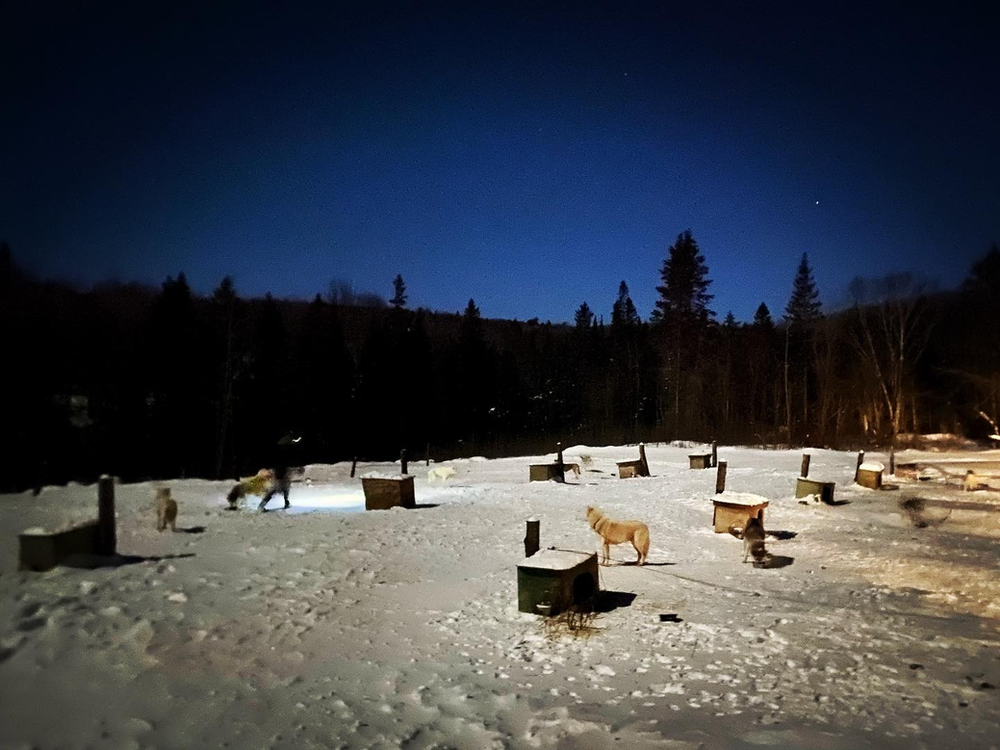
*A picture of our dog yard on a much calmer, starlit night*
Now it was time to notify the game warden. We snowmobiled off the ridge, only to find that Megan had already reached my wife. Several people were waiting on the road for news.
The warden said he would take my word for it, but his supervisor wanted him to investigate. It was nearly 11 PM when the warden arrived and unloaded his snowmobile. The snow was still coming down in blankets.
When the warden surveyed the scene — the moose prints, the broken dog houses, and where the moose had fallen — he confirmed the event was just as I had reported and issued a permit for us to harvest the meat if we wished. Sadly, the moose was still conscious. It took three more shots from the warden, at point-blank range to the skull, to finally put her to rest.
How rugged are these leftovers from the last ice age. How fierce. How noble.
I went home and started making phone calls to hunting friends. It was midnight. I had to be at work at 7 AM. And if the dogs were truly okay, we had a race in two days. I couldn’t burn the midnight oil over the next two nights processing a 750-pound animal.
Not surprisingly, none of my hunting friends were keen on getting out of bed in the middle of a snowstorm to snowmobile to a remote ridge and harvest a moose. But I knew that at the very least she would need to be field dressed to keep the meat from going bad.
“Where are you going?” my wife asked.
“Back out to field dress a moose.”
“Don’t be silly. Have you ever field-dressed a moose?”
“No. But I’ve dressed plenty of deer. It should be just that, only larger. If that moose had to lose her life tonight, the least we can do is honor it by not letting it go to waste.”
Caleb overheard and said, “I’ll go with you.”
We went back out. We laid our hands on the moose’s shoulder and said a prayer, thanking God for her life and promising to honor it by not letting the meat go to waste.
I’m so glad Caleb came. Without him I never could have muscled the animal around in the deep snow. Her hide was so tough it took five minutes with my dull knife to make the first incision. The snow was still falling hard. We finished at 2 AM. And yes, I still went into work at 7 AM.
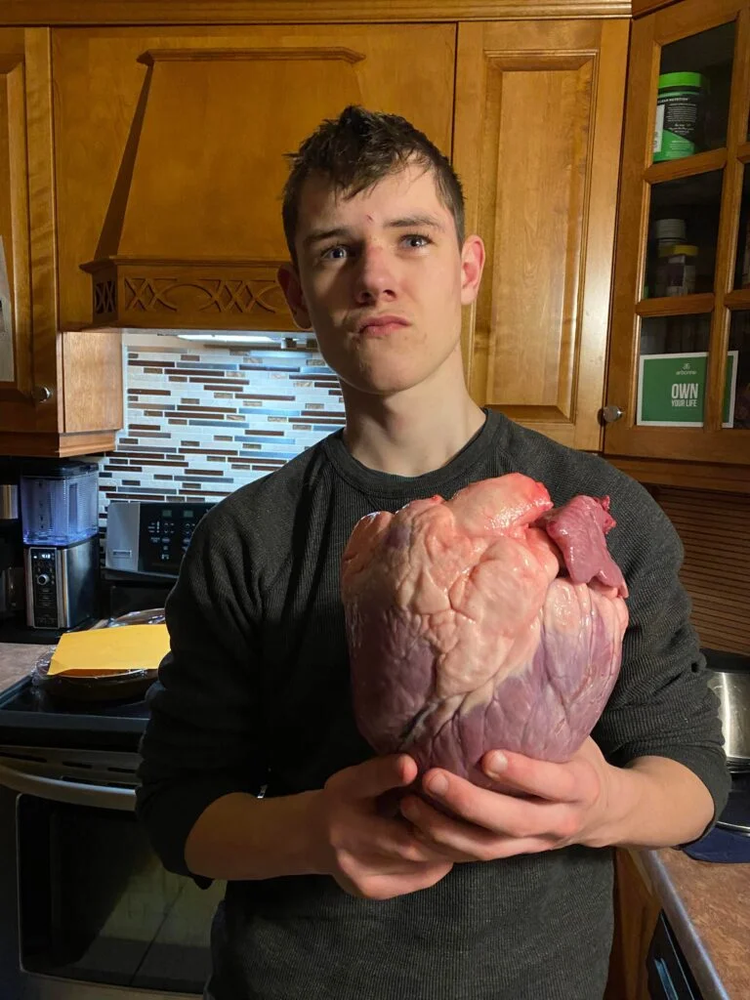
*Caleb with moose heart when we finally got home*
The following day the dogs looked unscathed. We decided to retire our oldest team members as a precaution and brought the pups home to monitor for a few days.
Before my school day was over, I began receiving messages and calls from state newspapers and TV channels wanting to cover the story. By the time I got out of work, Field & Stream Magazine had booked an interview with Caleb.
“Will you still run the race on Saturday?” the Field & Stream reporter asked.
“Yes,” Caleb said without hesitation. “We’ll tell the race veterinarians what happened and have the dogs looked over thoroughly. If they pass the veterinary inspection, we will race.”
The reporter pressed: “But you’ll be out on the trails at night again. Aren’t you afraid?”
Caleb smiled. “No. I love mushing at night. It’s when the dogs are at their best. This doesn’t change that — for them or for me.”
Friday night, after the race’s musher meeting, we went out to dinner. The lady at the next table smiled at me.
“I’m sorry, but I’m sure I know you — don’t I?” I asked.
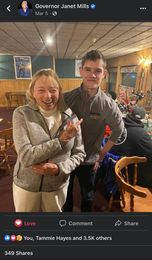
“I’m Janet Mills,” she replied.
It still took a moment to register.
“You’re Janet Mills — the Governor?” Yes, I often ask stupid questions.
She asked if we were all mushers there for the race. “Yes ma’am,” I said. “My son is competing this year.” I introduced them.
“Is this the young hero who saved his dog team and shot the rampaging moose?”
“Yes ma’am,” Caleb answered.
Here is a great photo the Governor posted to her social media — with Caleb.
Caleb went on to compete in the race that Saturday, completing 75% of the Can-Am 100-mile course before having to scratch after dark when his team refused to go further. We had females in heat contributing to the chaos, but it’s possible they also smelled the moose on the trail that the two preceding teams had encountered. We don’t know for certain.
But one thing we do know.
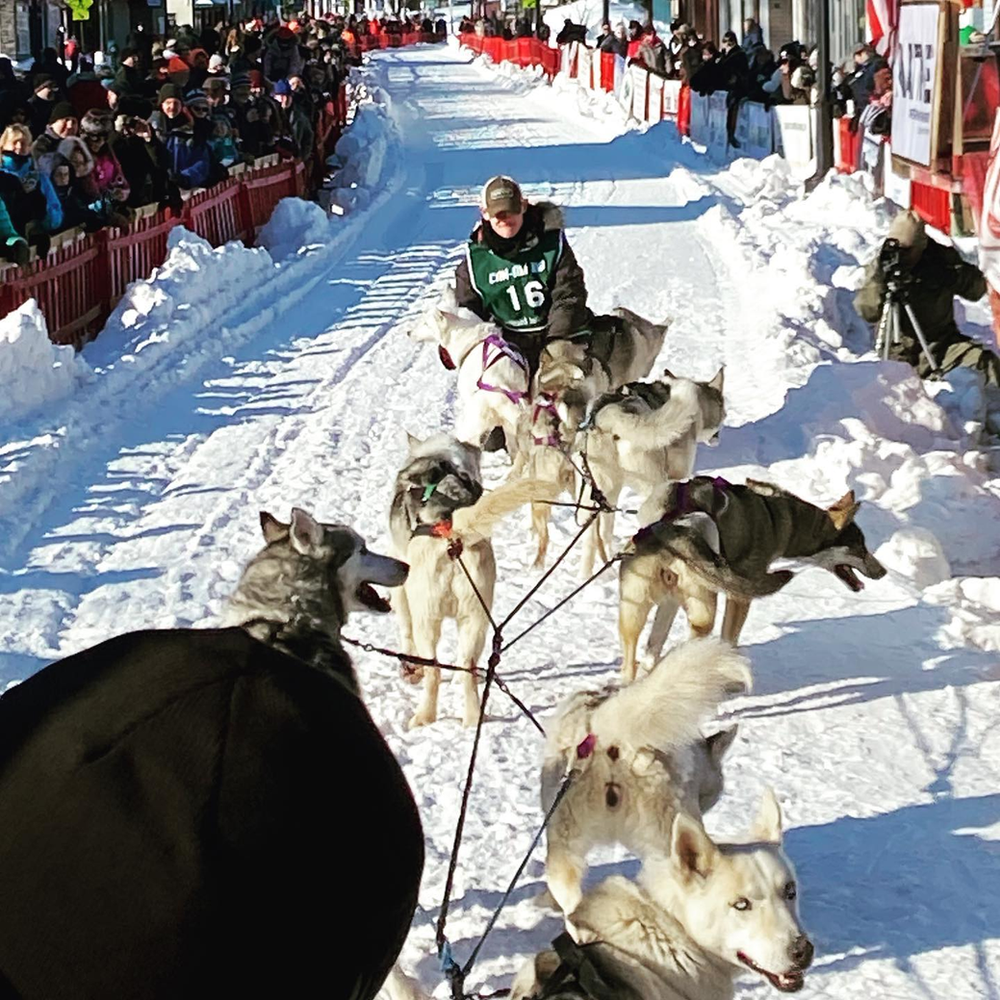
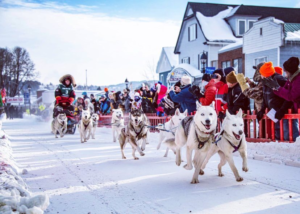
*Caleb in the starting chute of the Can-Am Crown International Sled Dog Race, three days after the moose attack*
Caleb says, “I will finish what I started and run that race before I go off to the U.S. Marines next year.”