Based on a true story. The first in a series of short stories – by Jonathan Nathaniel Hayes.
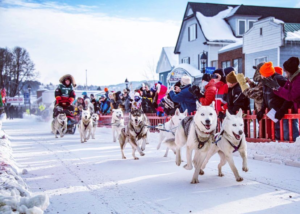
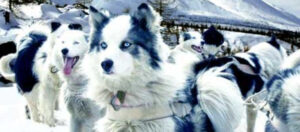
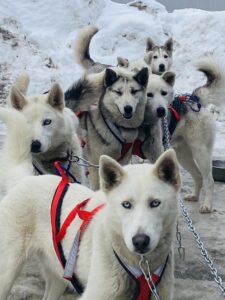
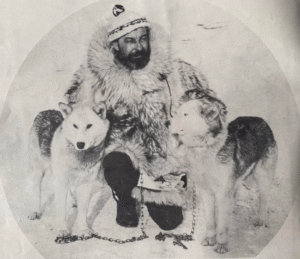
Getting tangled up: The team careened down the ridge at a full gallop. The icy snow rooster-tailed up from the bear-claw brake onto his reindeer skin leggings. This was a veteran distance dog team, and the past few miles had merely warmed up their muscles. The race trail took a hard left at the base of the hill. “Haw!” Seppala yelled, and the team swung instantly. But he couldn’t relax and enjoy the ride. “What’s the trouble ahead?” he said to his dogs. A team of eighty to one hundred pound Chinook dogs were tangled in a ball of fangs and flying fur. It was apparent to Sepp that this musher was overpowered and needed help to break up the team. “Whoa!” The team of Siberians had just gotten into their groove and were of no mind to stop. Seppala applied the brake to reinforce the command and his team finally came to a halt alongside the quarreling dogs. Seppala barked sharply at his dogs in a way that made it clear, he expected no funny business from them. He stepped off the runners of his sled to assist. Without a word, he set to work alongside the other musher, sorting the tangle of gangline and harness and fur. “Thank you so much for stopping!” Seppala was taken aback. It was a woman’s voice. “Of course!” he said, pausing to make eye contact with her. “That’s just swell!” she replied, as she flashed a flirtatious smile with a sparkle in her eye.
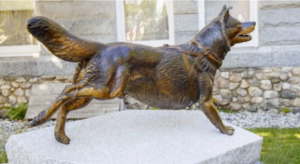
Elizabeth Ricker. The wife of Edward Ricker, owner of the Poland Spring Resort. Although she was a “fire bell,” Seppala would soon learn she was not to be defined by any man. “Liz,” she stated confidently. Elizabeth was the paragon of the “Flapper.” The 1920s saw women’s suffrage and a cultural revolution. They bobbed their hair, wore pants, and participated in activities like mushing that had been deemed too dangerous for women. Seppala, raised in Norway and the Alaska frontier, had never met a woman like Liz. Seppala went on to win the race that day. He posed for newspapers with his famed leader, Togo. “I will never sell Togo. He will be with me till the day he dies,” he told reporters. Liz was listening.

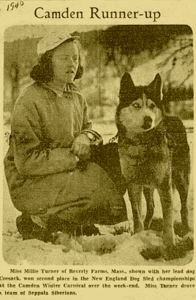
The proposition: The next day, rain canceled the race. Elizabeth invited Seppala to sit with her. “I want to ask you to consider retiring Togo with me here at Poland Spring. He will be king of the resort. I also want to make you an offer: partner with me. Here. In Maine.” Seppala took her up on it. Together they spent the next five winters dominating the racing circuit. Elizabeth became the most accomplished female musher in the world. But her love for him was paternal; she called him “father time.” In 1930, they trained in Quebec at the Grey Rocks Inn. There, they met Kare Nansen, son of the famous Fridtjov Nansen. Kare was twenty years younger, taller, and broader than Seppala. A whirlwind romance began between Kare and Liz.
Kare and Liz were married, and she prepared to leave for Norway. Teddy Ricker refused to pay their stay, so Liz gave her half of the dogs to Harry Wheeler. Wheeler offered Seppala a partnership, but Seppala counter-offered. “I will give you the remainder of the dogs in a year if you will allow me to finish the Olympic Race of 1932.”
“I’ll go home, Harry. Like the prodigal son, I’ve come to myself. I see that all this time, my wife Constance has kept the home fires burning. After the Olympic race, I’m going home.” Leonhard Seppala stayed true to his word. After his silver medal finish at the 1932 Olympic Exhibition, he returned to Alaska. By Constance’s side, he lived out the remainder of his 89 years.