“If You Are Cold, They Are Cold”: The Truth About Arctic Dogs
By Jonathan Nathaniel Hayes
When I was younger, I was easily sucked into online flame wars. But life is teaching me that few people who engage in such things are truly interested in learning anything. Today, however, my hand has been forced. I’d much rather be out running my dog team, but I will share some vital information here. What you do with it is up to you.
Background and Expertise
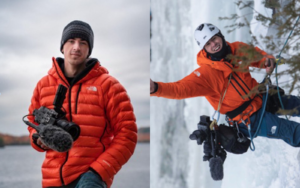
I earned my Bachelors in Wildlife Biology from the University of Maine. I conducted the most comprehensive morphological study of the wild canids (coyote/wolf) of our region ever completed and spearheaded two years of field research for a state Whitetail deer winter survivability study. I was extensively trained in cold weather at SERE school as a U.S. Infantryman and have served as both an environmental planner and a fisheries biologist. Finally, I have mushed for 19 years, including managing 165 sled dogs in the White Mountains of New Hampshire. I might know a little about this subject.
The Arctic Adaptation
Maine has a rich mushing heritage second only to Alaska. But Maine can get cold, right? By our standards, yes. We are tropical, bald, naked primates. However, animals like the Canada Lynx, Wolf, Moose, and Goshawk consider Maine the southern, warmer extent of their range. Their biological adaptations are for climates we consider inhospitable.
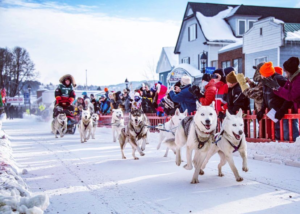
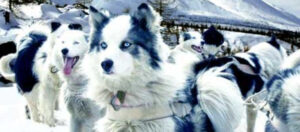
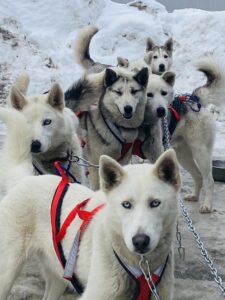
Sled dogs—specifically Siberian Sleddogs, Canadian Inuit dogs, Alaskan Malamutes, and Alaskan Huskies—are ARCTIC species. They are bred to thrive and work in -40°F. When the temperature drops below zero, they truly start to thrive. Their long guard hairs, wooly thick undercoats, and even specialized eyes (with less reflective tapetum to prevent snow blindness) are fine-tuned for the Arctic. To these breeds, a Maine summer is much more dangerous than a Maine winter.
Nutrition and Hydration
Sled dogs are the greatest endurance athletes in the world. They warm up from the inside out through caloric intake. Nutrition is everything. My team eats a more intentional diet and is trained more consistently than I am. You cannot force a dog to pull a sled; a team must be healthy, happy, and motivated.
Regarding water: the Arctic is a “desert” because water is frozen. These dogs have evolved to eat snow and ice. We “trick” them into drinking water by giving them “Mush”—flavored soup or chummed water with meat chunks—to ensure they stay hydrated while working.
The Comfort of the Snow
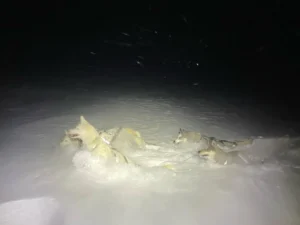
Years ago, during a terrible blizzard in northern Maine, I went out at night to check on my dogs. Their houses were empty. I panicked, thinking they had run away, and called for them. Suddenly, heads started popping up out of the snow. They knew instinctively that a blanket of snow provided a better micro-climate than a drafty doghouse. I had woken them up from a cozy sleep, and I apologized profusely to them.
The Danger of Anthropomorphism
Experts ranging from Cesar Millan to Iditarod champions agree: anthropomorphizing your dog is a leading cause of behavioral problems. Treating an Arctic animal like a human child does them psychological damage. It would be cruel to put a Poodle on a sled trail; likewise, it is cruel to deny an Arctic animal the conditions under which they thrive by forcing them into our hot homes.
I am fortunate to live in a community that understands these facts and in a state with regulations specifically designed for sled dogs. I encourage you to educate others: as G.I. Joe said, “knowing is half the battle.”